A lacrosse field may look similar to a soccer or football field, but it has its own structure, layout, and playing zones. From player positions to field markings and measurements, every element is designed to keep the game fast, strategic, and fair. Understanding the lacrosse field also helps new players, coaches, and parents learn how the game works.
This guide explains the official field size, zones, how many players are allowed on the field, and how it compares to fields used in other sports.
What Is a Lacrosse Field?
A lacrosse field is a rectangular playing area used in men’s and women’s lacrosse. It includes markings such as sidelines, end lines, a midfield line, restraining lines, goal creases, and scoring areas.
The field surface can be natural grass or artificial turf. High-level professional games often use turf because it provides consistent speed and ball bounce.
What Kind of Field Is Lacrosse Played On?
Lacrosse can be played on:
-
Natural grass fields
-
Artificial turf
-
Multi-sport athletic fields
Many schools and clubs use a shared sports field because the layout is similar to soccer or football. However, lacrosse requires additional markings—for example, the goal crease, restraining lines, and critical scoring zones.
Is a Lacrosse Field Called a Pitch?
Unlike soccer or rugby, the playing surface in lacrosse is not typically called a pitch.
The correct term is:
➡️ Lacrosse Field
However, in some countries like the UK, the term pitch may still be casually used.
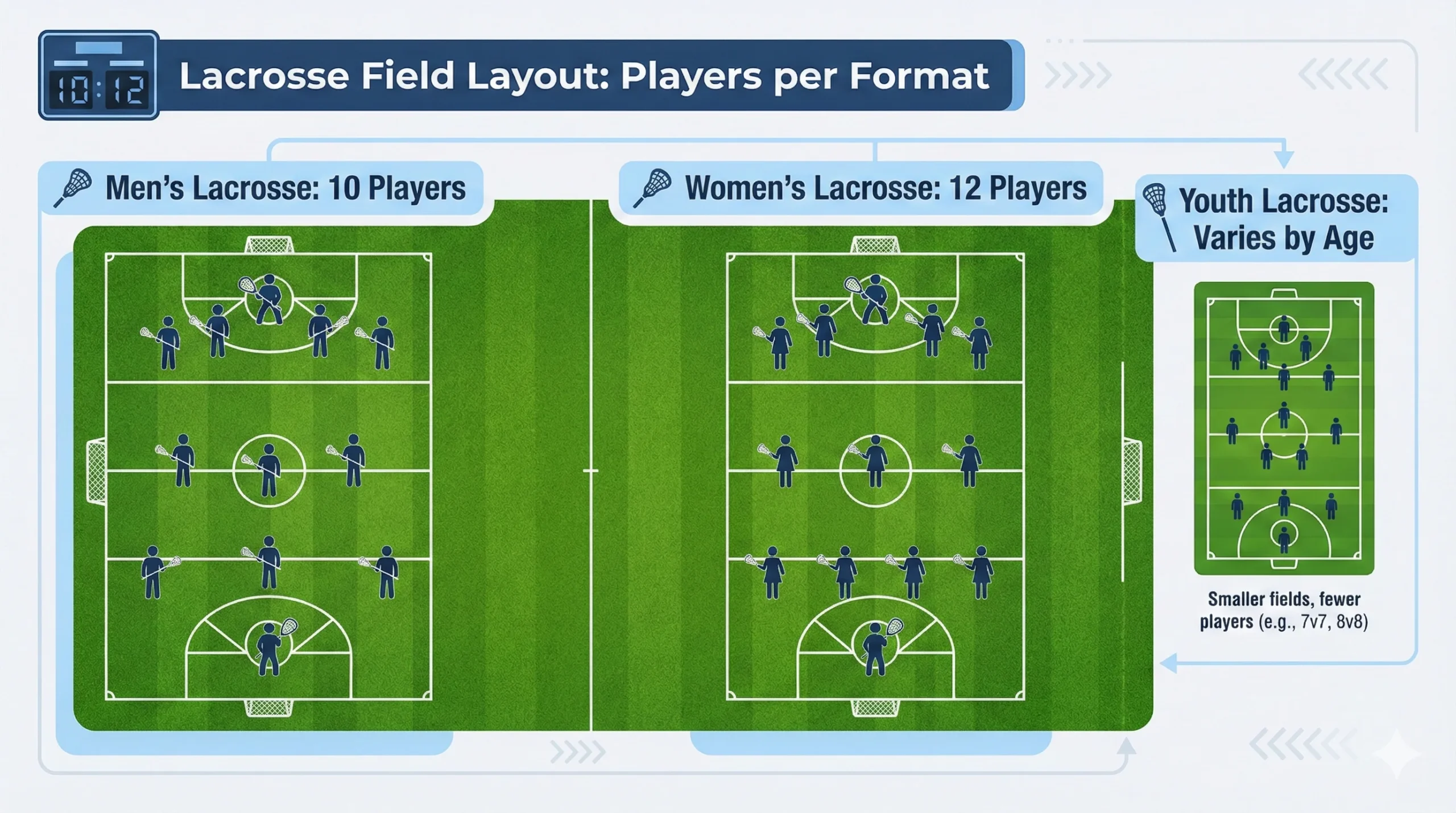
How Many Players Are on a Lacrosse Field?
The number of players depends on the format and gender rules:
| Version | Players per Team | Total Players on Field |
|---|---|---|
| Men’s Lacrosse | 10 | 20 |
| Women’s Lacrosse | 12 | 24 |
| Youth Lacrosse | 6–10 | Varies |
| Box/Indoor Lacrosse | 6 | 12 |
Only a limited number of players are allowed in each zone during gameplay to avoid offside penalties—in most cases, only six offensive and six defensive players may enter those areas.
Lacrosse Field Dimensions (Men’s and Women’s)
The size of a lacrosse field can vary based on the league, age level, and gender. However, the standard size for men’s lacrosse is 110 yards long and 60–70 yards wide.
Field Size Comparison Table
| Category | Length | Width |
|---|---|---|
| Men’s Field | 110 yards | 60–70 yards |
| Women’s Field | 110–140 yards | 60–70 yards |
| Youth Field | 60–70 yards | 35–45 yards |
Women’s lacrosse fields may be larger because physical contact rules are different and spacing helps reduce collisions.
Breakdown of Lacrosse Field Zones
A regulation lacrosse field is divided into three main sections.
Ref Lacrosse field
1. Attack Area
-
Located closest to the opponent’s goal
-
Players try to score or create passing opportunities
-
Only six players (or seven in women’s lacrosse) may enter
2. Midfield Area
-
Connects the two ends of the field
-
Typically 60 yards wide and 40 yards long
-
Used for faceoffs, passing plays, and transitions
Ref Lacrosse field
3. Defensive Area
-
Closest to a team’s own goal
-
Used by defenders and the goalie to prevent scoring
-
Limited players allowed to avoid offside violations
Ref Lacrosse field
Important Field Markings Explained
Below are the key lines and areas found on the field.
| Field Marking | Description |
|---|---|
| Sidelines | Define left and right boundaries (110 yards long). |
| End Lines | Behind each goal and 60 yards long. Crossing results in turnover. |
| Midfield Line | Divides field into offensive and defensive halves. |
| Restraining Lines | Prevents overcrowding in attack/defense areas. |
| Crease | 18-foot diameter circle surrounding the goal. Only goalie may enter. |
| Goal Line Extended (GLE) | Imaginary line used for positioning and shooting angles. |
These markings help maintain rule clarity and ensure smooth gameplay.
Ref Lacrosse field
What Is the Size of a Lacrosse Goal?
Although not part of the main keyword set, this is a relevant supporting query.
-
Goal opening: 6 feet x 6 feet
-
Goal sits in front of the crease
-
Ball must completely cross the line for a score
Comparison With Other Sports Fields
Lacrosse shares similarities with soccer, field hockey, and American football. However, several differences make it unique.
| Sport | Field Size | Goal Area Access | Player Contact |
|---|---|---|---|
| Lacrosse | 110–140 yds × 60–70 yds | Only goalie allowed in crease | Moderate–High (men) |
| Soccer | 100–130 yds × 50–100 yds | Players can enter goal box | Low contact |
| Field Hockey | 100 yds × 60 yds | Shots allowed only inside shooting circle | Low-Medium |
| Football | 120 yds total length | No scoring circle | High contact |
Lacrosse is most comparable to soccer due to field size and running patterns, but the crease and restraining line rules make the game strategically different.
(Source for additional reading: USA Lacrosse Official Rules — usalacrosse.com)
How Large Is a Lacrosse Field Today?
Modern lacrosse fields follow the standardized 110–140 yard length rule, depending on men’s or women’s division. Youth fields remain smaller to help developing players grow their skills.
With the sport expanding worldwide, many facilities are upgrading turf fields specifically marked for lacrosse.
Lacrosse Field Materials and Marking Specifications
-
Boundary lines: typically 2–4 inches wide
-
Goal line: exactly 2 inches wide
-
Surface: grass or turf
-
Color: usually white, but must contrast with turf
Automated robots are now used to paint fields accurately and efficiently.
Ref Lacrosse field
Summary: Key Facts About the Lacrosse Field
-
A lacrosse field is not called a pitch—it is called a field.
-
Standard dimensions range from 110 to 140 yards long and 60 to 70 yards wide.
-
Both men’s and women’s lacrosse use zones such as the attack area, midfield, and defensive area.
-
Only a limited number of players can enter specific zones to avoid offsides.
-
The goal crease is restricted and critical to gameplay.
Final Thoughts
Learning the structure and rules of the lacrosse field makes it easier to understand gameplay and strategy. Whether you’re a beginner, parent, or coach, knowing field dimensions and markings improves how you watch or play the sport.
As lacrosse continues to grow worldwide, consistent field measurements help standardize competition, build training programs, and support the sport’s future.
For official updates, consult:
🔗 USA Lacrosse Rules & Field Guides — https://www.usalacrosse.com
Leave a Reply